
NEWS TAG
brand
Best Low-VOC & Non-Toxic Flooring Options 2026
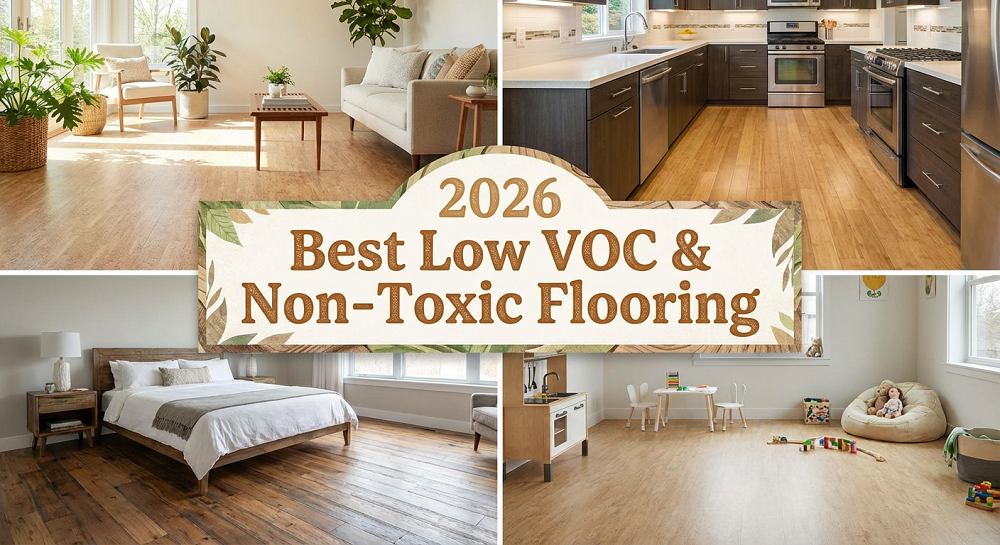
Most people pick flooring based on how it looks, how long it lasts, and how much it costs. But there's a fourth factor that deserves just as much attention: what your flooring releases into the air you breathe every day. In this blog, we will walk you through the top low VOC and non-toxic flooring options for 2026, how to choose the right one for your home, what "low-VOC" actually means in measurable terms, and answer the questions homeowners ask most often about healthier floors.
Why Low VOC & Non-Toxic Flooring Matters
Many conventional flooring materials, along with their adhesives, finishes, and underlayments, release volatile organic compounds (VOCs) into indoor air, and these chemicals have been linked to headaches, allergies, hormone disruption, and long-term respiratory issues. Choosing low VOC and non-toxic flooring is one of the most straightforward steps you can take to protect indoor air quality for your family, your pets, and anyone who spends time in your home.
Best Low VOC & Non-Toxic Flooring Options for 2026
Below are the top flooring choices that combine low chemical emissions, durability, and strong design for 2026.
1. Solid Hardwood Flooring
Solid hardwood remains one of the best non-toxic flooring options available. It's a single piece of real wood, typically ¾ inch thick, that can be sanded and refinished multiple times over its lifespan. Hardwood is naturally low in VOCs and brings warmth, character, and lasting value to any room.
The key to keeping hardwood truly non-toxic lies in the finish and the installation method. Pre-finished hardwood floors, where the coating is applied and cured at the factory, tend to produce fewer emissions than site-applied finishes. If you do finish on-site, water-based polyurethanes or natural oil-and-wax finishes are far cleaner than solvent-based coatings, which can off-gas for months. For installation, nail-down or floating methods are preferable to glue-down, since adhesives are a common source of VOC exposure.
Solid hardwood performs best in homes where humidity can be kept between 35% and 55%. In climates with extreme humidity swings, you may see more expansion and contraction, so professional installation is worth the investment. Look for FSC-certified wood to confirm the timber was responsibly sourced.
2. Engineered Hardwood Flooring
Engineered hardwood offers the same visual appeal as solid hardwood but with a layered construction that gives it more dimensional stability. A real wood veneer sits on top of multiple plywood or composite layers, which helps the flooring resist warping in environments where temperature and moisture fluctuate.
Because engineered hardwood involves adhesives in its layered construction, it's important to choose products that use formaldehyde-free or low-formaldehyde binders. Pair that with a water-based, low VOC finish and a floating or click-lock installation, and you get a floor that looks like traditional hardwood without the same chemical exposure risks. Many engineered hardwood products now carry FloorScore® or GREENGUARD Gold certifications, which verify that emissions meet strict indoor air quality standards.
Engineered hardwood also tends to cost less than solid hardwood and installs more easily, which helps if you're working within a tighter budget or placing flooring over concrete subfloors.
3. Reclaimed Hardwood Floor
Reclaimed hardwood is recycled wood salvaged from older buildings, barns, warehouses, or other structures. It gives floors a distinctive aged, character-rich appearance that new wood simply can't replicate. Because the wood has already been in use, often for decades, most of its original VOC off-gassing has long since occurred.
From a sustainability standpoint, reclaimed hardwood avoids the need to harvest new trees entirely. The main consideration is to verify that the wood has been properly cleaned, dried, and milled, and that any new finishes applied to it are low VOC or zero VOC. Availability can vary by region, and reclaimed wood sometimes comes at a premium due to the labor involved in sourcing and processing it.
4. Bamboo Flooring
Bamboo is technically a grass, not a tree, and it reaches full maturity in three to five years—compared to decades for most hardwoods. This rapid growth rate gives it strong sustainability credentials. Once installed, it looks and feels very similar to traditional hardwood, and strand-woven bamboo can be even harder than oak or maple.
The main thing to watch for with bamboo is the adhesive used to bind the fibers or layers together. Some manufacturers still use formaldehyde-based glues, which undermine the health benefits of choosing a natural material. Look for bamboo flooring that explicitly states it is formaldehyde-free and uses water-based adhesives. The Forest Stewardship Council (FSC) also certifies bamboo products to confirm they were sustainably harvested without damaging local ecosystems.
Bamboo is not ideal for very humid environments unless it has been specifically treated for moisture resistance, so keep that in mind if you're installing it in a bathroom or a region with high ambient humidity.
5. Cork Flooring
Cork is harvested from the bark of cork oak trees, and because only the bark is removed—not the tree itself, the same tree can be harvested every nine years for up to 250 years. This puts cork among the most renewable flooring materials on the market. It's naturally hypoallergenic, antimicrobial, resistant to mold and mildew, and has a soft, cushioned feel underfoot that's comfortable for standing and walking.
Cork also provides natural sound insulation, which is a bonus for multi-story homes or rooms where noise reduction matters. It's available with either natural oil finishes or water-based acrylic coatings, and both options can be sourced in low VOC formulations. Some cork flooring is even produced from recycled wine corks, adding another layer of environmental benefit.
On the downside, cork can dent under heavy furniture and may show wear in high-traffic areas if not properly sealed. It's also sensitive to prolonged moisture exposure, so it's best suited for living rooms, bedrooms, and home offices rather than bathrooms or laundry rooms. As with any glued-together flooring product, confirm that the adhesive is formaldehyde-free.
6. Natural Linoleum (Marmoleum)
Natural linoleum, often sold under the brand name Marmoleum, is one of the most genuinely eco-friendly flooring options you can buy. It's composed of linseed oil, pine resins, wood flour, cork dust, and natural pigments pressed onto a jute backing. It contains no PVC, no phthalates, and no petroleum-based plastics, and it's fully biodegradable at the end of its life.
Linoleum doesn't off-gas the harmful fumes associated with vinyl and other synthetic resilient flooring. It's durable, available in a wide range of colors and patterns, and easy to clean with mild, non-toxic products. Many homeowners find it to be an ideal replacement for vinyl in kitchens, playrooms, entryways, and utility areas.
One thing to keep in mind is that, like vinyl, linoleum can trap moisture if installed in very humid rooms or directly over concrete without a proper moisture barrier. It may also yellow slightly with prolonged sun exposure, though this is cosmetic rather than a health concern.
7. Ceramic and Porcelain Tile
Ceramic and porcelain tile is one of the oldest and most naturally non-toxic flooring options in existence. Both are composed primarily of clay, shaped and fired at high temperatures, and the finished product contains no VOCs whatsoever. Tile is also hypoallergenic, water-resistant, mold-resistant, and extremely durable, it can easily last the lifetime of a home with minimal maintenance.
The area where tile can introduce chemical concerns is in the installation materials. Adhesives, grouts, and sealers may contain VOCs or other additives, so it's worth choosing low VOC or zero VOC thinset mortar, latex-free grout, and non-toxic grout sealers. For the cleanest install, the traditional thick-set method (a mortar bed) uses no chemical adhesives at all, while the modern thin-set method is still clean and low-odor. Sanded grout is porous and typically needs sealing to prevent water penetration and potential mold growth, just be mindful that the sealer itself is non-toxic.
One additional note on imported tiles: some may contain lead-based glazes or asbestos fillers, so purchasing from reputable manufacturers with documented safety standards is a smart move. Factory-glazed tiles that don't need extra finishing once installed are the safest bet. Porcelain tile is also a good conductor of heat, pairing well with radiant floor heating systems, which can help lower energy costs in warmer climates.
8. Natural Stone Floor
Materials like marble, slate, granite, limestone, and soapstone are naturally free of VOCs because they are, quite literally, quarried rock. Natural stone floors carry an upscale look that suits both contemporary and traditional interiors, and they're exceptionally long-lasting.
The main consideration with stone is the sealer. Most natural stone needs periodic sealing to prevent staining and moisture penetration, and that sealer should be a low VOC or zero VOC product. Outside of the sealer, stone floors produce no chemical emissions at all.
Natural stone does require more upkeep than tile or hardwood, certain stones can scratch, etch, or stain if not maintained, so it's worth factoring in ongoing care when choosing this option. It's a strong choice for homeowners who want a premium, all-natural floor and are comfortable with the maintenance involved.
9. Concrete Flooring
Concrete is another inherently non-toxic flooring material. It's composed of cement, sand, water, and aggregate, and it releases nothing harmful into indoor air once cured. Concrete floors can be stained, polished, stamped, or imprinted with patterns, giving them a wide range of visual possibilities beyond the industrial look most people associate with bare concrete.
Because concrete doesn't need adhesives, underlayments, or complex finishes, it sidesteps many of the chemical exposure points that come with other flooring types. If you do apply a finish or stain, choose water-based, low VOC options.
Concrete is durable, easy to clean, and works well with radiant heating. It is hard underfoot and can feel cold, so it's best paired with rugs or mats in rooms where comfort matters. It's an excellent fit for modern, industrial, or minimalist home designs.
10. Wool Carpet
If you prefer soft flooring, wool carpet is the healthiest carpet option available. Wool is a natural, renewable fiber that's inherently flame-resistant, stain-resistant, and dust-mite-resistant without the chemical treatments that synthetic carpets rely on. It doesn't off-gas formaldehyde, phthalates, or other VOCs, and it's fully biodegradable.
Conventional synthetic carpet is one of the bigger offenders when it comes to indoor chemical exposure, it can release VOCs from the fibers, backing, adhesive, and flame-retardant treatments all at once. Wool carpet avoids all of these. When installing, opt for natural jute or wool padding underneath rather than synthetic foam padding, and use a low VOC or zero VOC adhesive, or better yet, choose a stretch-and-tack installation that uses no glue at all.
Wool carpet does cost more than synthetic alternatives and requires regular vacuuming and periodic professional cleaning. But for bedrooms, living rooms, and nurseries where a soft, warm floor is a priority, it's hard to beat in terms of both comfort and indoor air quality.
11. Rubber Flooring
Rubber flooring is a quiet, comfortable, and slip-resistant option that's naturally resistant to mold, moisture, and heavy wear. Many rubber flooring products are manufactured from recycled materials and meet strict air quality certifications. Low VOC rubber flooring is commonly used in gyms, playrooms, basements, and utility areas, but residential-grade options with more refined finishes are increasingly available for kitchens, mudrooms, and other living spaces.
When selecting rubber flooring, look for products certified under FloorScore® or GREENGUARD Gold, and confirm that the adhesive (if a glue-down installation is used) is also low VOC. Rubber is durable, recyclable, and comfortable underfoot, a practical choice for spaces that see a lot of activity.
How To Choose Low VOC & Non-Toxic Flooring?
Picking the right low VOC flooring involves more than just selecting a material type. The floor itself is only one part of a system that includes adhesives, underlayments, finishes, and installation methods—and each of these can either protect or compromise your indoor air quality.
Third-party certifications are the most reliable way to verify that a flooring product meets tested emission standards. FloorScore® certifies hard surface flooring and adhesives for low VOC emissions. GREENGUARD Gold applies stricter chemical limits and is often required for spaces used by children and the elderly. CRI Green Label Plus covers carpet, carpet cushion, and carpet adhesives. If a product carries one of these labels, it has been independently tested and verified. When you're shopping, ask the supplier for documentation, certification logos, emission test reports, and Safety Data Sheets (SDS) for every product that will be part of the installation.
Even a certified low-VOC floor can become a source of chemical exposure if it's installed with high VOC glue or sealed with a solvent-based product. This is one of the most common and easily avoided mistakes in non-toxic flooring projects. Always specify low VOC or zero VOC adhesives, primers, sealers, and grout for the entire installation system, not just the flooring material itself. A floor is only as clean as the weakest link in its installation.
Installation method matters just as much. Floating and click-lock installations avoid adhesives entirely, which eliminates one of the biggest sources of VOC emissions. Nail-down installations are also cleaner than glue-down methods. If glue-down is your only option, use a product that carries GREENGUARD Gold or FloorScore® certification. During and after installation, ventilate the space well, open windows, run fans, and allow fresh air to circulate for several days to help any residual emissions dissipate.
For wood, bamboo, or cork floors, the finish is a major variable. Water-based polyurethanes and natural oil-and-wax finishes produce far fewer emissions than solvent-based coatings. Pre-finished floors—where the coating is applied and cured in a factory setting, tend to off-gas less than floors finished on-site, since factory curing happens in controlled conditions with industrial ventilation.
Matching the flooring to the room's conditions is also important for long-term air quality. Moisture-sensitive materials like hardwood, cork, and linoleum perform best in rooms where humidity stays between 35% and 55%. Tile, concrete, and stone are better choices for bathrooms, basements, and other spaces with higher moisture exposure. Choosing the right material for each room prevents moisture-related problems like mold growth, which creates its own set of indoor air quality concerns.
Finally, think about ongoing maintenance. A low VOC floor should be cleanable with mild, non-toxic products. Floors that require harsh chemical cleaners or frequent resealing with strong solvents can reintroduce VOCs into your home over time. Before committing to a flooring material, ask what cleaning and maintenance products the manufacturer recommends, and confirm they align with your goal of keeping your indoor air as clean as possible.
How Low Is the Low VOC Flooring?
"Low VOC" is a relative term, and the specific emission levels depend on which certification program a product meets. There is no single universal standard, but several well-recognized programs define what qualifies as low-emission flooring, and knowing the numbers behind them gives you a clearer picture of what you're actually getting.
FloorScore®, managed by the Resilient Floor Covering Institute (RFCI) in partnership with SCS Global Services, tests hard surface flooring and adhesives against the California Section 01350 standard. Products that pass meet some of the strictest indoor air quality requirements in the United States. The testing measures emissions of specific compounds—including formaldehyde, acetaldehyde, and total VOCs—over a defined period after manufacturing.
GREENGUARD Gold (formerly GREENGUARD Children & Schools) sets even tighter limits. Products carrying this certification meet emission thresholds designed to be safe for sensitive populations, including children, the elderly, and individuals with respiratory conditions. GREENGUARD Gold limits total VOC emissions to 220 micrograms per cubic meter and formaldehyde to 9 micrograms per cubic meter within a standardized testing chamber.
CRI Green Label Plus applies specifically to carpet, carpet cushion, and carpet adhesives. It tests for over a dozen individual VOCs and sets maximum allowable concentrations for each.
For context, "zero VOC" does not always mean zero emissions in an absolute sense. Most products labeled as zero VOC contain fewer than 5 grams of VOCs per liter, which is the threshold set by many regulatory definitions. In practice, this is an extremely low level, and these products produce little to no detectable odor.
It's also worth noting that a product's tested emission level may not perfectly mirror real-world conditions. Temperature, humidity, ventilation, and the age of the product can all influence how much a floor off-gasses once installed. That said, certified products consistently perform better than non-certified alternatives, and the gap between a FloorScore®-certified floor and an uncertified conventional product can be quite large. The certifications don't guarantee zero exposure, but they do guarantee that emissions fall within tested, health-conscious limits, and that difference matters when you're breathing the air in your home every day.
One more thing to keep in mind: the "low VOC" label on a floor applies only to the floor itself. If the adhesive, primer, grout, or sealer used during installation is not also low VOC, the total system emissions can be much higher. Always verify that every component in the installation carries its own certification or meets documented emission limits.
FAQs About Low VOC & Non-Toxic Flooring
What exactly are VOCs, and why are they a concern in flooring?
VOCs (volatile organic compounds) are gases released by certain solids and liquids, including some flooring materials, adhesives, and finishes. Common VOCs found in flooring include formaldehyde, benzene, toluene, and various phthalates. Indoors, these compounds can accumulate, especially in tightly sealed buildings, and contribute to symptoms like headaches, dizziness, eye and throat irritation, and allergic reactions. Long-term exposure to certain VOCs has also been associated with more serious health conditions, including respiratory disease and hormone disruption.
Is vinyl flooring low-VOC?
Standard vinyl (PVC) flooring is one of the more problematic options from a health standpoint. It can release vinyl chloride fumes, phthalates, and other chemicals, particularly when new. Some manufacturers have introduced improved vinyl products that use phthalate-free plasticizers and carry low VOC certifications like FloorScore® or GREENGUARD Gold. These are a better choice if vinyl is your only viable option due to budget or accessibility, but naturally non-toxic alternatives like linoleum, tile, and hardwood remain cleaner from an indoor air quality perspective.
Does low VOC flooring cost more than conventional flooring?
In some cases, Yes! Low VOC products can carry a modest price premium, especially for certified hardwood, bamboo, or wool carpet. However, many naturally low VOC options like ceramic tile, concrete, and linoleum are competitively priced or even cheaper than their conventional counterparts. The cost difference also tends to shrink when you factor in the benefits: fewer health-related complaints, faster safe occupancy after installation, and compatibility with green building programs that can add value to your property.
Can I install low VOC flooring myself, or do I need a professional?
Many low VOC flooring products, particularly click-lock engineered hardwood, floating cork, and peel-and-stick linoleum—are designed for DIY installation. However, hiring a professional is worthwhile for materials like solid hardwood, tile, and natural stone, where proper subfloor preparation, moisture management, and precise installation matter for both durability and air quality. If you do install yourself, follow the manufacturer's ventilation guidelines closely and use only the recommended low VOC adhesives and finishes.
Will low VOC flooring eliminate all odors after installation?
Not always, but odors will typically be much milder and dissipate faster compared to conventional flooring. Good ventilation during and after installation helps any residual smell clear more quickly. If you're particularly sensitive to chemical odors, ceramic tile, natural stone, and concrete are the closest to truly zero-emission options.
What's the difference between "low VOC" and "non-toxic" flooring?
Low VOC refers specifically to a product's tested emission levels, how many volatile organic compounds it releases into the air. Non-toxic is a broader term that considers the overall chemical composition of the material, including any toxins that might be present even if they don't off-gas in large quantities, such as heavy metals in glazes or phthalates in plastic flooring. A floor can be low VOC without being fully non-toxic, and vice versa. Ideally, you want flooring that qualifies as both: low in emissions and free from harmful chemical ingredients.
How do I know if my existing flooring is high in VOCs?
If your flooring has a persistent chemical smell, especially noticeable when the room is warm or closed up, that's a common indicator of ongoing VOC off-gassing. Laminate, vinyl, and certain engineered wood floors installed without attention to emission standards are the most likely culprits. You can check with the manufacturer for SDS (Safety Data Sheet) documentation or have an indoor air quality test performed by a qualified professional.
If I already have high VOC flooring, what can I do?
Increasing ventilation is the most immediate step, open windows regularly and use fans to circulate fresh air through the space. Avoid using harsh chemical cleaners on the floor, which can add more VOCs to the air. Over time, most flooring products off-gas at decreasing rates, so emissions tend to drop as the floor ages. Air purifiers with activated carbon filters can help reduce airborne VOCs in the meantime. If the flooring is a major concern, particularly in a nursery, bedroom, or other frequently occupied room, replacing it with a certified low VOC option is the most effective long-term solution.
What certifications should I look for when shopping?
The three most widely recognized certifications are FloorScore® for hard surface flooring and adhesives, GREENGUARD Gold for products meeting strict emission limits suitable for sensitive environments, and CRI Green Label Plus for carpet and carpet adhesives. FSC (Forest Stewardship Council) certification is also worth looking for with wood and bamboo products, it doesn't measure VOC emissions directly, but it confirms that the material was responsibly sourced, which is an important part of the broader non-toxic and sustainability picture.
Can low VOC flooring be used in every room of the house?
Yes, but the best material choice varies by room. Ceramic tile, porcelain, natural stone, and concrete are ideal for bathrooms, kitchens, and basements where moisture exposure is frequent. Hardwood, engineered hardwood, bamboo, and cork are better suited for living areas, bedrooms, and offices where humidity can be controlled. Wool carpet works well in bedrooms and living rooms but should be avoided in moisture-prone areas. The goal is to match each room's conditions with a flooring material that will perform well without creating moisture or mold problems down the road.